
It’s that time of year again. College students are heading to campus for the beginning of the fall semester. Many students are also starting their college experience from home, preferring to do online learning instead of going the traditional in-person route. And now more college students than ever are using nootropics to help them study for exams, write papers, and keep up with the demands of academic life.
If you’re a college student and you’re interested in nootropics, this article is for you. We’re going to discuss whether it’s a good idea or not to take nootropics in college and then look at some of the best nootropics for college students. But first let’s see why nootropics have become so popular with both undergraduate and grad students.
Why do college students use nootropics?
For anyone who has experience with nootropics, the answer to this question is obvious. People who have been using nootropics for a while know that they can improve memory and mood, increase focus and motivation, and decrease anxiety and stress.
But for anyone who is new to the wonderful world of nootropics, they might be unsure of what these so-called smart drugs have to offer. People are often skeptical when they hear that there are substances that can improve cognitive performance without causing any negative effects.
I’ll be honest: I was skeptical at first, too. When I first learned about nootropics more than a decade ago, I found it hard to believe there were substances that could have a noticeable effect on cognition without any unwanted effects. But once I started to experiment with different nootropics, all my doubts were removed.
To learn more about the reasons why people use nootropics in general, check out this post: Why Use Nootropics?
Here are some of the reasons why college students in particular use nootropics:
- Improve memory
 Increase focus
- Improve mood
- Reduce anxiety
- Increase motivation
- More effective studying
- Pull all-nighters/Stay up late to do schoolwork
- Increase sociability
- Improve overall cognitive performance
Nootropics can do all of these things and more. Whether you’re cramming for an exam or pulling an all-nighter to finish a research paper, there are nootropics that can help.
But is it a good idea for college students to take nootropics? Let’s explore that question now.
Should college students use nootropics?
For some reason, performance enhancement is often frowned upon in American society. Many Americans believe it’s fine to use drugs to treat medical conditions but not to improve performance (or to simply feel good).

For example, it’s okay to take testosterone if you have a deficiency, but not okay to use it to improve sports performance. Or it’s okay to take drugs if you’re depressed and want to feel better (antidepressants), but it’s not okay for healthy people to take drugs to feel better than normal (weed, mushrooms, LSD, etc.).
Yet, in spite of popular opinion, millions of Americans (and others around the world) use performance-enhancing drugs (PEDs). It should come as no surprise that many of the top leaders in business, government, sports, and other competitive industries use some sort of performance-enhancing substance.
Whether or not you feel it’s right or wrong is up to you. But if you’re here reading this, you’re obviously at least considering trying a nootropic or two. So the real question is: should you use nootropics?
Only you can answer that. There is no reason to believe that taking nootropics would have any kind of negative effect on college students that they wouldn’t have on older adults. And while you probably shouldn’t take them if you’re under the age of eighteen, there doesn’t seem to be any special risk for taking nootropics in college.
If you decide that nootropics are right for you, there are several that can help you succeed in college. I’m not going to tell you which nootropics to use or even that you should use them at all – that’s up to you. However, I am going to tell you about some nootropics commonly used by college students. Let’s take a look at some of the most popular nootropics being used by students around the world now.
Nootropics for college students
Modafinil

One of the most-popular and effective nootropics available today is modafinil. It’s used by college students all over the country (and world) for its ability to improve cognitive functioning.
Modafinil is classified as a eugeroic – a wakefulness-promoting agent. In several countries, it’s a prescription drug used to treat narcolepsy (excessive daytime sleepiness), sleep apnea, shift work sleep disorder, and other conditions.
Nootropic users have been using modafinil for years for not only its ability to increase wakefulness but also for its focus-and-motivation-enhancing effects. Users often report being more productive, being able to work longer hours, and having more focus and energy.
College students especially like using modafinil to help them pull all-nighters. Because it is a wakefulness-promoting substance, modafinil can help you keep your eyes open and your mind sharp all night long.
A very-similar substance, armodafinil, has also been getting popular with college students. It works just like modafinil but the effects last a little longer and, milligram for milligram, armodafinil is a little bit stronger.
Common dosages for modafinil range from 100 milligrams (mg) to up to 400 mg. Most users experience its benefits with between 1-200 mg. Armodafinil, on the other hand, is usually taken at a dosage of either 150 mg or 300 mg.
If you’re interested in learning more about these substances, you may want to read the following: Modafinil, Adrafinil, & Armodafinil – Which Is Better? And if you decide you want to purchase modafinil and/or armodafinil, check out this post: Where To Buy Modafinil Online in 2026.
Bromantane
 This substance has really gotten popular over the past few years. Bromantane is currently one of the best-selling nootropics around the world. That’s because users find that it helps them feel both motivated and relaxed at the same time. This interesting substance can provide mental and even physical energy while promoting a state of calm focus.
Bromantane, like many nootropics, was first developed in Russia. It’s been used as a prescription drug (sold under the brand name Ladasten) in some countries to treat a variety of ailments. And it’s been used as a performance enhancer by athletes and scholars alike. In fact, Bromantane is so effective at improving performance that it’s been banned by WADA (World Anti-Doping Agency), the agency that tests athletes for PEDs (performance-enhancing drugs).
While bromantane hasn’t caught the attention of many American researchers, it has been extensively studied worldwide. Russia has done the most research and their studies consistently show that bromantane can increase both physical and mental energy. When taken for nootropic purposes, dosages of 50-100 mg are typically used.
To learn more about this potent energy booster and productivity enhancer, check out this post: The Nootropic Benefits of Bromantane.
Caffeine & L-Theanine

It’s no secret that college students love caffeine. Nor is it a secret that people in general love caffeine (I, personally, very much love caffeine). Millions of Americans use caffeine every day to help them stay awake, be productive, and fulfill all their responsibilities. In fact, caffeine is the most widely used drug in the world.
Caffeine and L-theanine together make a simple-yet-effective nootropic stack that is popular with college students. It provides all the benefits of caffeine but without the jitters, crash, and other negative effects that often come with caffeine use.
The nootropic benefits of caffeine are well known: increased wakefulness, improved mood, more energy, better focus, etc. That’s why so many people drink coffee, energy drinks, and other caffeine-infused beverages. But what does L-theanine add to the mix?
L-theanine is a non-essential amino acid that is naturally found in green tea. When taken in high-enough doses, it can decrease anxiety and promote a sense of calmness. And when taken with caffeine, it can reduce or even eliminate many of caffeine’s unwanted effects.

L-theanine is found naturally in green tea.
People who use caffeine and L-theanine report a calm sense of focus with no jitters or crash a few hours later. It is commonly used at a 2:1 ratio of L-theanine to caffeine. So a typical starting dose would be 200 mg of L-theanine and 100 mg of caffeine.
For me, I find 400 mg of L-theanine and 200 mg of caffeine to be my personal sweet spot. It really does help to get into a state of relaxed focus.
To learn about other nootropics that go well with caffeine, check out this post: Nootropics That Stack Well With Caffeine.
Racetams
 This isn’t a single substance – it’s an entire class of smart drugs. The racetams are all chemically similar substances, several of which have a known nootropic effect. Many racetams have been widely studied and a number of them are popular in the nootropics community. Here are some of the more common racetams being used by college students:
Piracetam – This is the substance that inspired the creation of the word nootropic. Piracetam has been shown to improve memory and learning. Some users also find that it can improve mood and reduce anxiety. You can learn more about piracetam (as well as the origin of the word nootropic) here: Piracetam – The First Nootropic.
Aniracetam – This racetam is especially popular among people who suffer from anxiety. Aniracetam has been shown to increase focus and memory while decreasing anxiety. You can learn more about it here: Aniracetam for Anxiety and Focus.
Oxiracetam – This racetam is popular for the exact opposite reason as aniracetam. Oxiracetam has been shown to improve memory and increase focus without having any effect on mood or anxiety levels. You can learn more about it here: Oxiracetam – A Safe and Effective Nootropic.
 Phenylpiracetam – This one is very popular with college students. Some people even find phenylpiracetam to be as effective as the prescription drug Adderall. You can learn more about it here: Phenylpiracetam – The Best Adderall Alternative.
Fasoracetam – Like aniracetam, this one can have both focus-enhancing and anxiety-reducing effects. Many users find that fasoracetam reduces anxiety even better than aniracetam. You can learn more about it here: Fasoracetam – An Anxiety-Reducing Nootropic.
These are five of the most popular racetamic nootropics, but there are many more like sunifiram and pramiracetam, among others. To learn more about this interesting class of nootropics, check out this post: The Best Racetams – A Comparison.
Rhodiola rosea (and other adaptogens)

A rhodiola rosea plant.
The last nootropic for college students we’re going to mention is rhodiola rosea. It’s in a class of nootropics called adaptogens. These are substances that help the body to normalize itself, correcting any imbalances it may have.
Rhodiola rosea (often just called Rhodiola) and other adaptogens can have a wide variety of benefits. Some of the more common ones that people report include improved memory and mood, decreased anxiety, increased focus, and enhanced learning.
Unlike modafinil, caffeine and L-theanine, and the racetams, rhodiola and other adaptogens generally don’t start working right away. While some of their effects may be felt after the first dose, most won’t become noticeable until after a couple weeks of taking them daily.
For this reason, rhodiola and other adaptogens aren’t very helpful when it comes to boosting acute mental performance for things like all-nighters or studying marathons. But when taken daily for at least a couple of weeks, nootropics like rhodiola can definitely help to improve cognitive performance over time for some people.
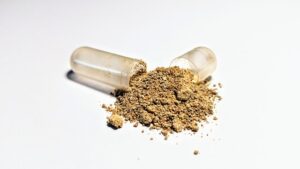
Ashwagandha capsule.
Other popular nootropic adaptogens include ashwagandha, bacopa monnieri, and mucuna pruriens. They’re all plants that grow naturally in various parts of the world and have been used in traditional medicine for centuries. And each of them has its own set of nootropic benefits to offer.
Rhodiola is usually taken in a dosage of anywhere from 300-800 mg a day. Studies show that it’s safe to take over a gram (1,000 mg) a day for long periods of time. You can learn more about rhodiola here: The Benefits of Rhodiola Rosea.
To learn about other nootropic adaptogens, check out this post: The Top 5 Natural Nootropics.
Conclusion

Every year, more and more college students are using nootropics to help them get better grades. Whether you’re looking for something to help you focus, worry a little less, improve your mood, or a combination things, there may be a nootropic that can help you with your studies. Speaking of studies, you may also want to check out the following: The Best Nootropics For Studying.
As always, I should mention that it’s a good idea to consult a licensed healthcare professional before starting any new supplements, drugs, diets, workout plans, or behavioral routines. Since doctors aren’t taught about nootropics in medical school, you might have to educate yours a bit. This website can be a great place for them to start. Many of the articles on this website are heavily cited, giving doctors plenty of nootropic science to dig into.
If you’re looking to buy some the nootropics mentioned in this post, check out NextChems. They have a great assortment of products – nootropic and otherwise. They carry a number of peptides, nootropics, and other substances. Their prices are reasonable, the quality of their products excellent, and they have a great reputation. And best of all, if you use the coupon code cqmybnmb when ordering from Kimera Chems, you’ll get 10% off your whole order! They really are one of the best place to buy research chemicals, nootropics, peptides, and other exotic substances. NextChems is the go-to source for researchers, nootropic users, biohackers, and everyone else who is serious about cognitive enhancement.
Have you ever used any nootropics to help with schoolwork? If so, what have you tried? Please leave your answer in the Comments section at the bottom of the page. And if you haven’t already, sign up for the Nootropics Zone newsletter below to learn about dozens of other brain-boosting substances.
To learn more about nootropics, sign up for the Nootropics Zone newsletter. You'll get the free gift, The Ultimate Nootropics Quick Reference Guide.
[This article was originally published on August 28, 2018. Updated September 11, 2026.]





Of couse college students should try nootropics to increase their cognition.Just focus on mental areas that you think require improvements.Everyone has their own issues.Research and experiment will get you results.Eventuall you will find what works for you.It will take time but be patient and don’t get frustrated.It can take weeks and even months.
If you are frustrated with struggling to learn like I was, some of these things have been a lifesaver